
Image
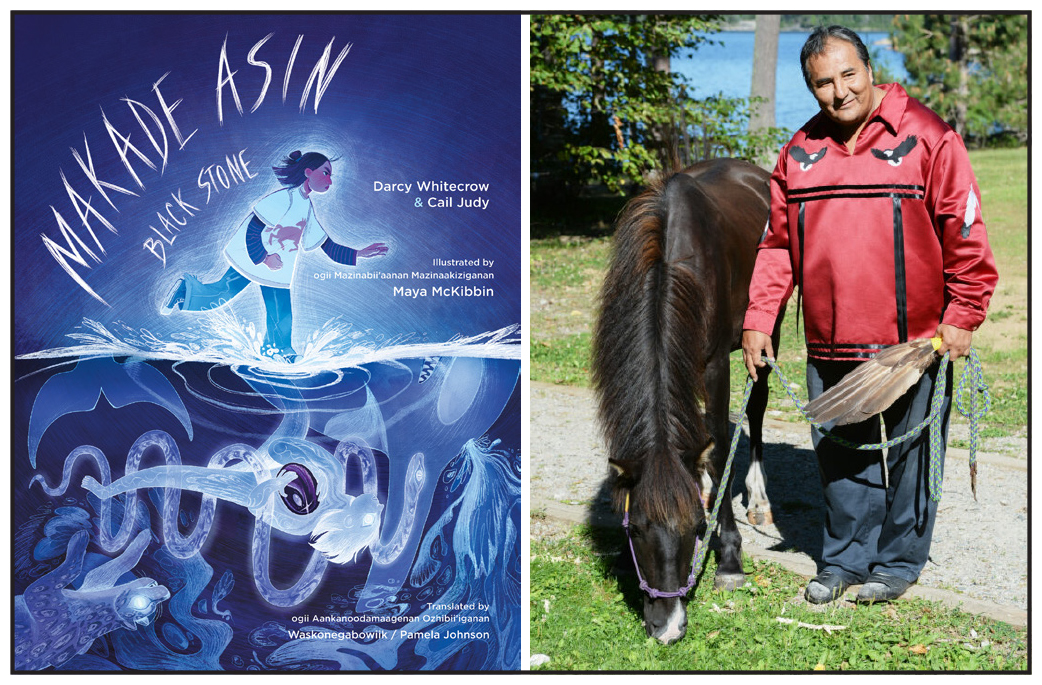
Image Caption
Windspeaker.com Books Feature Writer
Local Journalism Initiative Reporter
The traditional Ojibwe story Makade Asin/Black Stone is a true collaboration between co-writers Darcy Whitecrow and Cail Judy, Waskonegabowik, an Anishinaabemowin translator of the Ginozhe clan, and Ojibwe/Irish illustrator Maya McKibbin.
“We had several team meetings and several exchanges back and forth on email as to what the message was trying to be conveyed in each of the scenes,” said Whitecrow. Ojibwe/Dakota and a member of the Seine River First Nation in northwestern Ontario.
Makade Asin/Black Stone is the story of the four-year journey of a young boy who is scared. His grandfather sets him off to find the black stone that will stop him from being afraid. In his quest to find the stone, he stares down a jaguar in the jungle, escapes the killer whale in the ocean, and beats up the snake in the desert. When he finally returns home, his grandfather says, “Welcome home, Black Stone.” The acknowledgement shows that the black stone of courage lay within the boy.
Whitecrow is pleased with McKibbin’s vibrant illustrations and creativity, stating that McKibbin “wanted to make the book their masterpiece.”
As for Waskonegabowik’s work, she writes at the end of the book, “It is difficult for me to translate English words to Anishinaabemowin. I had to think hard because some words in English can be translated literally or by the intended meaning. For this book, I tried for the intended meaning.”
Whitecrow says he and Waskonegabowik agreed to keep the translation basic because the book is aimed at children from ages three to eight years.
“It's a simple message, and that's where your real self-esteem comes from. Once you accept the good and bad of you, this is where you're going to find your real strength in life is within. You accept all your imperfections as a human being. That's kind of the concept of happiness too,” said Whitecrow.
There are different traditional versions of the Black Stone story, he adds, but this one originates from Seine River.
“The book was written because of the present-day situation where there's a lot of youth and you try to reach the young people. They're so impressionable at this time and this stage of their lives, and they really aren't making any decisions until up to 30 years old about what they want to do or what they want to be with their lives,” said Whitecrow.
Too many have their self-esteem influenced by social media, he said, being told how they are supposed to look, or are being cyberbullied.
When he was 10 years old, says Whitecrow, his father had him do his first fast to look at “the possible paths that I would be taking in life.”
Unlike the other children at that time in Seine River First Nation, Whitecrow didn’t attend residential school and was raised in a traditional life. His parents hid him in the bush when the RCMP came to take away the children. Whitecrow grew up speaking Anishinaabemowin. He didn’t learn English until he was 15 years old.
“I've been a traditionalist all my life, and I am considered a knowledge keeper and a young Elder. I believe that we need to start collecting some of these teachings and some of these things and writing them down,” said Whitecrow. “Every time we lose an Elder, we lose a library of knowledge because of that history. We need to record (stories) whether there's people speaking out against it or not because once that Elder is gone, that knowledge of that family also goes with that Elder.”
These stories, he says, are what connect his people to the land and nature, to their culture, to their sense of purpose and to their identity.
Makade Asin/Black Stone is published by Groundwood Books, an imprint of House of Anansi Press. It will be released Aug. 4. It can be purchased at https://houseofanansi.com/products/makade-asin-black-stone?srsltid=AfmBOoqrV_RN2Y899CjGDezNcjcqpKgmnX8v_c2c6SgTk0p64GvqN9Ue