
Image
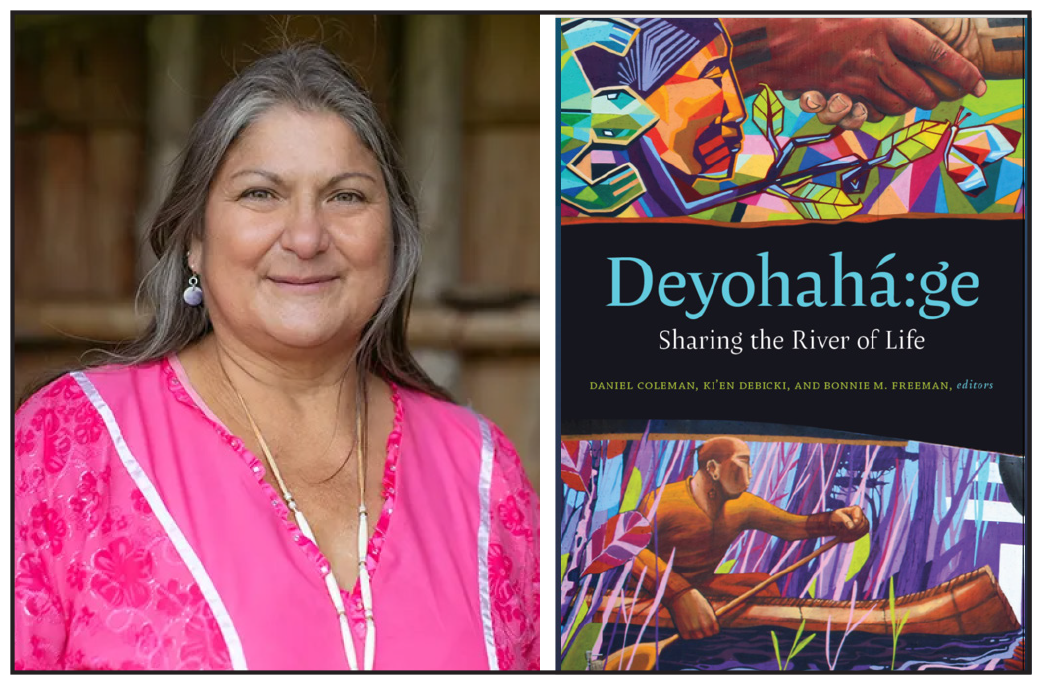
Image Caption
Windspeaker.com Books Feature Writer
Local Journalism Initiative Reporter
Deyohahá:ge: Sharing the River of Life is one of five scholarly books recognized this past June with a 2026 Canada Prize for being “most inspiring and transformative.”
The book brings together Haudenosaunee knowledge keepers, scholars, community voices, and allies to “show that the Two Row (Wampum) is not just a legal or political framework, but also an ethical and spiritual guide for how we share the River of Life,” said co-editor Dr. Bonnie M. Freeman, Algonquin/Mohawk from the Six Nations of the Grand River Territory.
“It asks readers to move beyond seeing the Two-Row as treaties and as documents locked in the past. It invites people to understand treaty as a relationship.”
In the Cayuga language, Deyohahá:ge means “two roads or paths” and evokes the Great Law of Peace, which is the foundation of the Haudenosaunee and directs the Two Row Wampum and the Covenant Chain.
These wampum agreements came about just after the arrival of the Dutch, then with the English and later the French. While these agreements were formulated with early settlers, says Freeman, an associate professor at McMaster University in Hamilton, they still exist today and apply to all non-Indigenous people who have come to North America.
“We recognized and saw the different beliefs and values,” said Freeman. “And that's what the Two-Row talks about. It's about the parallel relationships…and to be respectful of each other.”
The Two Row Wampum, originally a belt made of quahogs (hard clams), consists of two purple rows separated by three white rows. One purple row represents the Haudenosaunee in their canoe, and the other purple row represents the colonists or non-Indigenous in their ship. The belt shows the vessels running parallel, following their owns laws and beliefs and not steering the other’s vessel. The white rows between the purple rows are based on the philosophy of the Great Law of Peace and speak to being respectful, living in peace, and the importance of friendship.
“When we hold the wampum up, we hold it vertically. We don't hold it horizontally. The purpose of holding it vertically shows that they're equal relationships. If you hold it horizontally, you see one row higher than the other,” said Freeman.
The Covenant Chain Wampum has the image of people on either side of a line, which represents the chain, originally a rope. But as a rope deteriorates, the line became an iron chain. But as iron rusts, the chain then became silver. Shaking the chain summons support from the other partner.
“Now with the silver chain…we can polish that relationship,” said Freeman.
Deyohahá:ge is written in sections beginning with the philosophy of the Great Law of Peace, progresses to how people think about it, and concludes with action that can be taken. In its collection of 12 essays, Deyohahá:ge looks at how the brotherly relationship between the Haudenosaunee, acting as big brother, and settlers in the little brother role has given way to settlers serving as patriarchs.
“For settlers or non-Indigenous people, they have not passed along this information (about the Covenant Chain-Two Row Wampum) to their people, to their families or through their lives. They've forgotten it,” said Freeman. “So we're bringing forward this and reminding people of these early agreements that are still in existence even today. We still feel that these are very important relationships and agreements that have been put forward.”
Deyohahá:ge is looking for a change to be enacted in today’s world.
Freeman and co-editors Ki’en Debicki, Wolf Clan Kanien’kehá:ka (Mohawk), and Daniel Coleman, of British-Scandinavian ancestry, are all professors at McMaster University in Hamilton.
In 2007, Freeman and Coleman, together with representatives from McMaster, Six Nations Polytechnic and Haudenosaunee Elders, met. From there the Deyohahá:ge Indigenous Knowledge Centre, housed at Six Nations Polytechnic, was born. McMaster collaborates closely with the knowledge centre.
In 2015, Freeman began thinking about gathering stories to look at how the concepts and principles of the Great Law of Peace were being integrated into the lives and work of both the Haudenosaunee and non-Indigenous settlers.
When COVID hit, the plans for a gathering shifted to focus on a book.
The Canada Prize award acknowledged Deyohahá:ge for its “powerful reminder that scholarship can deepen our understanding of foundational agreements and the responsibilities they continue to carry.”
The award, funded by the Social Sciences and Humanities Research Council and awarded by the Federation for the Humanities and Social Sciences, comes with a $4,000 prize. That money will be donated to the Six Nations Polytechnic Deyohaha:ge Indigenous Knowledge Centre, says Freeman.
Deyohahá:ge: is the first title in publisher Wilfred Laurier University Press’s Indigenous Imagining series edited by Daniel Heath Justice. He is the Canada Research Chair in Indigenous Textual Sovereignties and a distinguished university scholar at the University of British Columbia.
“In a time of increasing incuriosity, cruelty and hostility toward transformative scholarship, Deyohahá:ge: is a profound and generous work that deeply considers how we can live, think and dream together better,” said Justice.
Freeman says Justice’s comments are prefaced on how Indigenous academics, in particular, face resistance as they ask people to question and confront what they’ve learned or are being told.
“We can just head-think it and philosophize it, but the importance of (Deyohahá:ge:) is that we go beyond that,” said Freeman. “When you embody this understanding, and that's through the process of learning about it, that we live it. The principles and the philosophy become a part of us and…it comes out of us through our actions…And that's important in building relationships and not just building but maintaining and working through relationships.”
Deyohahá:ge: Sharing the River of Life can be purchased at https://www.wlupress.wlu.ca/Books/D/Deyohaha-ge3