
Image
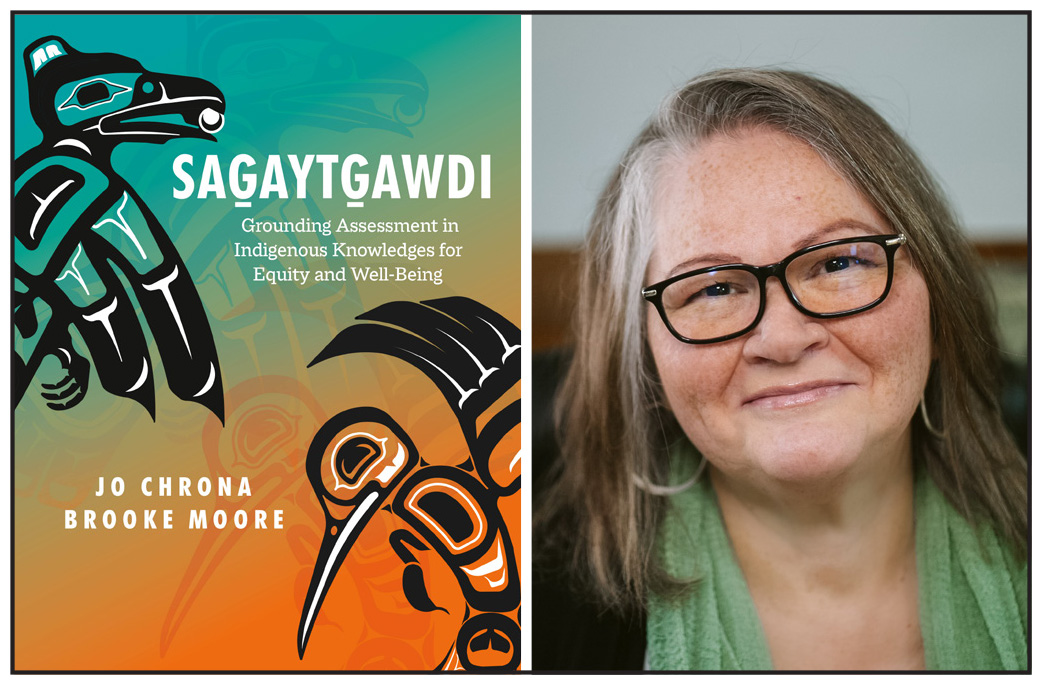
Image Caption
Windspeaker.com Books Feature Writer
Local Journalism Initiative Reporter
By implementing new assessment practices that emphasize Indigenous knowledge systems and perspectives, educators “can reclaim humanity…for all learners,” write co-editors Jo Chrona and Brooke Moore in their new bookSag̱aytg̱awdi: Grounding Assessment in Indigenous Knowledges for Equity and Well-Being.
Assessment is the process of gathering information in order to understand a student’s learning. That information can either stifle learning or further that student’s learning, the book posits.
“In schools and classrooms…many folks have used assessment practices as gatekeeping practices…If we want education systems that are vibrant and exciting and places that… nurture and support us to continue to grow and to learn, then we have to understand assessment in a different way,” said Chrona, an educator, philosopher and member of the Kitsumkalum First Nation, B.C., with Ts’msyen and European heritage.
“A part (of) that is recognizing that every decision that we make is impacting that human being that's connected to that decision.”
In Sag̱aytg̱awdi (a Sm’algyax word meaning “gathering together”), Chrona and Moore, an educator of European ancestry, contend that assessment and equity are directly connected.
“A system focused on equity endeavours to ensure that the quality of education a learner receives is not dependent on their background,” they write.
Sag̱aytg̱awdi examines that connection further with chapters and classroom practises that look at how equity in education can be employed so there is no disparity between educational outcomes of different groups of learners.
Chrona notes that educators are influenced by their own experiences, where they come from and where they are at specific points in their lives. Since they bring this into the classroom, culturally neutral, objective or apolitical academic classes or programs do not exist. Being aware of how these biases can impact the teaching situation is important.
“Anyone connected to an education system is in a place of privilege because the decisions that we make, what we say, what we do, impacts the lives of learners and their families and our larger communities. And if we're going to be in a place like that, then we need to hold that responsibility very carefully,” she warned.
There is a “relational system” between the educator and individual student and that system requires educators to meet students where students are at and to bring them along from that spot.
“While colonial perspectives often value categorization and the isolation of parts, Indigenous knowledge systems tend to value holism and relational connections,” they write.
Chrona also points out that although the actual word “assessment” is not used in Indigenous knowledge systems, assessment is still part of both the teaching and learning processes.
As curriculum is value-laden and reflects the values of the larger society, assessment of learning also reflects what the larger society deems to be important. Chrona and Moore propose that equity-centred assessment ensures that the culture contexts of learners are taken into consideration when assessments are designed.
Chrona and Moore caution educators against labelling racism and other disparities as systemic issues and believing that there is nothing an individual educator can do to address these inequities. Chrona admits that for some educators it will be a challenge to adjust their usual practises and look at operating in a different way.
“There are still people who think about equity in terms of lowering standards for everybody. That's absolutely not the case. This is about creating systems that support everybody, hold everybody up to find ways to support them to achieve and to thrive,” she said.
Making changes so that educators assess their teaching practises to ensure they are meeting the learning needs of each of their students can be daunting with large class sizes, she says, but it’s not about changing everything the educator does all at once.
“It won't be practical (so) we ask folks to think about what's one thing you can do this year that may be a bit different,” said Chrona. “How it's done will depend on who the educators are, who the students are, what the contexts are, because so much of this is about responding to the context of who learners are, who educators are, and where the learning is happening.”
Changes are complex and should not be oversimplified, write Chrona and Moore, but at that same time, they don’t have to be overwhelming and they don’t need to involve additional government funding.
To encourage educators to make changes, Sag̱aytg̱awdi includes a lengthy section of stories in which teachers share the practices they employed which resulted in changes that served their learners and, in turn, energized them as educators.
For example, Luana T., a primary-years teacher, gives her students options for how they may want to “represent their learning at the end of every learning cycle.” If they don’t like her options, she encourages them to define their own ways of sharing. Then there’s Michelle W., a secondary science teacher, who moved toward learning goals, working with her students individually to determine “the relevance of those goal to their lives…(making) the learning more purposeful…”
Chrona says fear causes some educators to not change their conventional classroom so stories of how educators have been successful helps breakdown that resistance.
Sag̱aytg̱awdi is geared towards Kindergarten to Grade 12 educators but Chrona notes that changes need to be made in university as to how teachers are educated about assessments. She adds that she will be making presentations at post-secondaries when requested.
Chrona says everyone can benefit from what Sag̱aytg̱awdi has to offer and that is one reason why each section ends with mind, emotion, spirit, and action “reflection questions such as “how do you feel when you are required to do something in a specific way versus when you have the freedom of some degree of choice?” or “How do you think we can create learning environments that exhibit both compassion and high expectations?”
Sag̱aytg̱awdi also offers additional sources and helpful resources.
“Folks definitely not even remotely connected to education (can benefit) because I think underscoring all of it is remembering the purpose of education systems and the purpose of a lot of the work that we do (is) about individual and community and society's well-being and what are we doing in education and in all of our roles or in families and society in general that supports that,” said Chrona.
Sag̱aytg̱awdi: Grounding Assessment in Indigenous Knowledges for Equity and Well-Being is published by Portage and Main Press and will be released Sept. 15. It can be purchased through https://www.portageandmainpress.com/Books/S/Sagaytgawdi