
Image
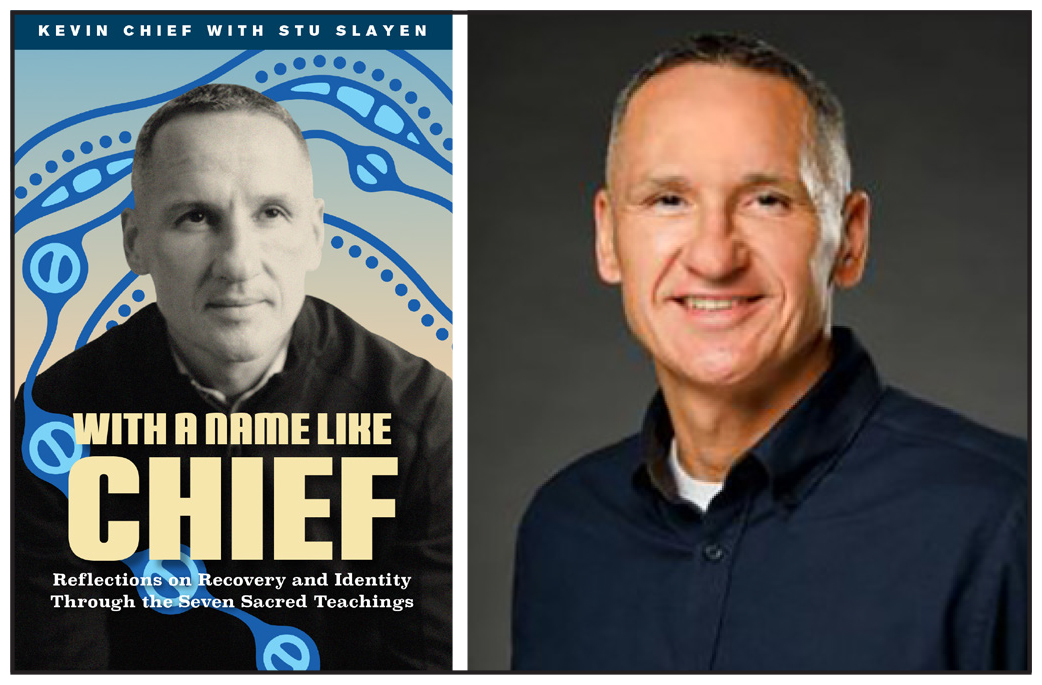
Image Caption
Windspeaker.com Books Feature Writer
Local Journalism Initiative Reporter
There is power in story, says Kevin Chief, author of With a Name Like Chief: Reflections on Recovery and Identity Through the Seven Sacred Teachings.
Chief found that power in the stories told Friday nights at the sobriety birthday parties hosted by Alcoholics Anonymous.
“What was special about Fridays is you could find a meeting in Winnipeg, and I could go listen to someone's story and it was like medicine. So I'd listen to someone's story and then I'd feel good for the weekend that I could stay sober,” said Chief, a member of Minegoziibe Anishinabe First Nation (Pine Creek) in Manitoba.
He also found power in stories told by Indian residential school survivors, who had the courage and humility to share. He learned about grace and forgiveness.
“One of the things that we have to be able to do if we want to have more grace in our life, if we want to find peace, is to forgive ourselves, to forgive our parents, to forgive people who've harmed us,” said Chief.
“I realized how much I learned listening to the stories of survivors around the (Truth and Reconciliation Commission) process and that got me thinking about what my dad would have said. I wish he could have testified.”
Instead, Chief’s father Norman turned to alcohol to hide his pain and protect his family from his memories of residential school. The result was that Chief’s mother walked away from her abusive marriage and left Kevin to be raised by his father.
“The TRC process was so powerful because the survivors shared those stories. And so, I thought, ‘Well, maybe I could share some of my dad's stories and my life with my dad.’ And then that would be a gift to my children, not just today and tomorrow, but when they're future dads. And I thought to myself that would be a beautiful gift to be able to give them,” said Chief.
Chief worked with communications specialist Stu Slayen to write With a Name Like Chief. The book recounts Chief’s own remarkable accomplishments, including serving in the Manitoba legislature from 2011 to 2017; his relationship with Manitoba Premier Wab Kinew; and his capacity as advisor to the Winnipeg Jets, the first team in the NHL to deliver a land acknowledgement. The book also acts as a gateway for his three sons to get to know their grandfather, who passed away in 1993.
Chief attended his first AA meeting on March 25, 2002 on the ninth anniversary of his father’s passing. Norman Chief was never able to gain sobriety.
Along with working the 12 steps of the AA program, Kevin embraced the Seven Sacred Teachings—love, respect, courage, honesty, wisdom, humility and truth—and a “resilience model” called the Circle of Courage. Usually employed for youth at risk, the Circle states youth need four core values to thrive—belonging, mastery, independence, and generosity.
“Mino-bimaadiziwin is an Anishinaabe word that means ‘to live a good life’. The good life could mean different things to different people, but to me that teaching has always meant about living a sober life,” said Chief.
“When I think about it, one of the critical teachings of that was to not necessarily find a solution, but to have a framework that would guide me in my life to not only get sober but sustain a life of sobriety.”
Along with the Seven Sacred Teachings, Chief embraced the four values of the Circle of Courage. Chief said the Circle “gave me the language and almost gave me a purpose to work towards to serve others.” The Seven Sacred Teachings “was a framework to guide my own life. The other one provided me the language and the know-how to serve others. And it came together at a really critical time in my life when I was trying to get sober,” said Chief.
As for the title of his book, Chief said he developed and matured as he did because of his surname.
“That name used to elicit a sense of shame and embarrassment for me growing up,” he said. “With some awareness and, of course, a lot of support from people in the community, I started to realize that although my name growing up could have been associated with my dad's struggle with alcoholism, with our struggles with poverty, with being ashamed that I was Indigenous…I don't know if I could be as grateful as I am if I didn't go through the struggles.”
Chief hopes his book is part of a journey for others.
“The advantages of using the Seven Sacred Teachings of the Anishinaabe (is that) they are universal values. And the reason that I think that that's so critical with reconciliation is that the more personal we can make reconciliation, the better our understanding is,” he said.
With a Name Like Chief: Reflections on Recovery and Identity Through the Seven Sacred Teachings is published by HighWater Press and will be released Sept. 1. It can be purchased at https://www.portageandmainpress.com/Books/W/With-a-Name-Like-Chief