
Image
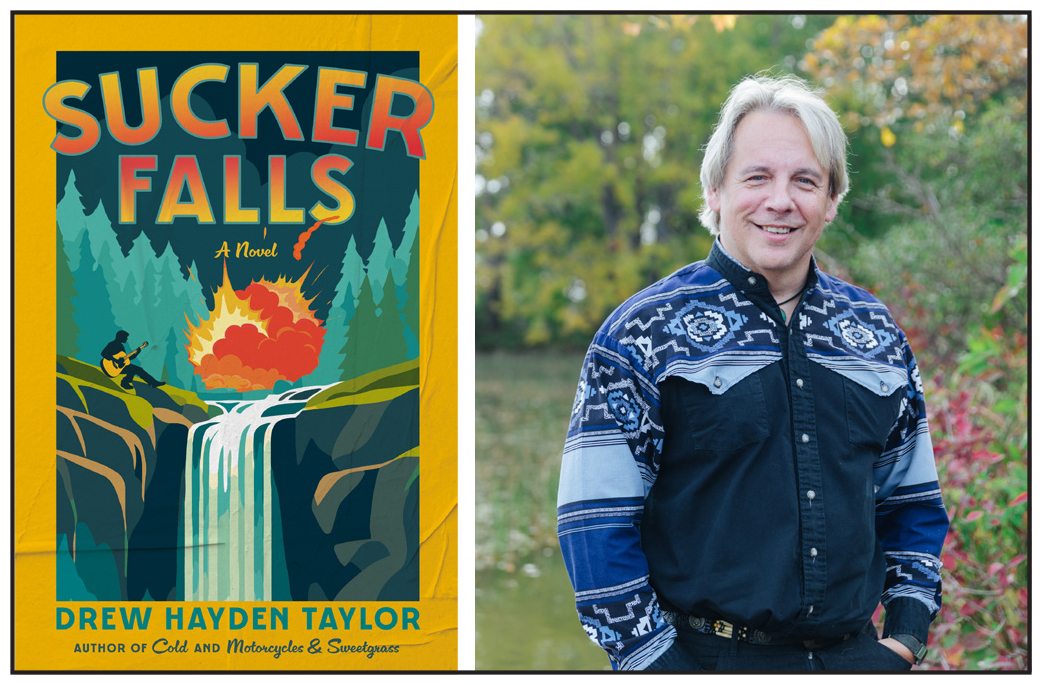
Image Caption
Windspeaker.com Books Feature Writer
Local Journalism Initiative Reporter
For Drew Hayden Taylor, Ojibway author from the Curve Lake First Nation in Ontario, Ladybug LaFlesche “is one of my most favourite characters ever created.”
Ladybug drives the narrative in Taylor’s newest novel Sucker Falls.
Ladybug is a survivor. She builds Casino N’Gataage — “a shining example of Indigenous sovereignty” — on her home, Sucker Falls First Nation, that has yet to be granted reserve status by the Canadian government.
She plans to bulldoze Chief Nick Best’s hereditary home so she can build an airport. She signs an agreement with the Diamond Boys for royalties for minerals that go deeper than the ‘six inches below the ground rule’ as a failsafe to her initial monetary plans. She uses fear to rule her two sons. She keeps three levels of government and two police forces at bay as she schemes.
“One of the things I've come across in my past life is sometimes I will write a questionable negative character, and I'll get people saying to me, ‘Is that what you really think of this kind of person or that kind of person?’ And with Ladybug, I just loved her determination, her steel will,” said Taylor, who points out he was raised by strong women.
Taylor created Ladybug for his 2001 play Sucker Falls: A Musical about Demons of the Forest and the Soul. The play is an Indigenous adaptation of Kurt Weill’s opera Rise and Fall of the City of Mahagonny.
Rise and Fall is a political satire critiquing Berlin of the 1920s and its rampant prostitution, unstable government, political corruption and economic crises. Or, as Taylor jokes, “life on a reserve.”
He says he has often heard casinos referred to as “the new buffalo” and wanted to show in his play and the book how that faith is “frequently misplaced.”
Take for example Ladybug’s belief in her casino. N’Gataage is an Anishnaabemowin word meaning “I will play.” As she tells Chief Nick, “In a scant few years, the buzz phrase all will be speaking, the t- shirt all will be wearing, the chant of wealth will be ‘N’Gataage— I will play.’ It has a ring to it, wouldn’t you say?”
“I'm not really saying anything good or bad about casinos,” stressed Taylor. “I just wanted to tell a what-if story about the possible evils of casinos.”
In the Sucker Falls play, the spirit of the Wendigo hovers over the community and the casino. The Wendigo has a pivotal role in what transpires.
“Many people associate the Wendigo spirit with cannibalism, but, in reality, when you dig deeper into its story…it's about insatiability, it's about appetite. Any kind of appetite, including greed, gambling, all that sort of stuff,” said Taylor.
The author had “tapped into” the Wendigo for his previous novel, Cold, so he wanted to move away from the creature for Sucker Falls, the novel.
“I came at (Sucker Falls) from a different angle, sort of the community standing up and through the chief who rightly or wrongly took things into his own hands,” Taylor said.
With the characters already developed through the play, Taylor just needed to add Chief Nick and build up the involvement of the community and Ladybug’s impact on it. The novel took him four to six months to write.
Taylor’s writing is clever, informal and casually humourous.
“I guess the best way to describe my writing style is it started from a fondness and a comfortability with dialogue, writing dialogue, how people talk and the fact that you can create a whole persona, a character, from how they talk,” he said.
Taylor’s writing career began with television. He then turned to theatre, as well as writing articles, essays and columns. In the early 2000s, he began writing novels. Sucker Falls is his 37th.
“I think my storytelling comes from my television and theatre writing and my belief in the importance of humour in the Indigenous community,” he said.
Taylor points to a conversation he had with an Elder on the Blood Reserve in Alberta.
“He told me that in his opinion humour is the WD-40 of healing. So I heard that and I thought about it and for me that made perfect sense because WD-40, it helps, encourages, it promotes, it fixes a lot of things, and I feel that's what humour in our community does,” Taylor said.
“So I try to incorporate that in almost everything I write. No, I shouldn't say that. I don't try and incorporate that because that means that it takes effort. I just think it's such a part of the culture I grew up in that it organically shows up in my writing.”
Taylor has never taken any formal writing classes.
Sucker Falls also includes some “inside jokes” that will jump out to Indigenous readers. But that doesn’t mean Taylor writes only for an Indigenous audience. As he points out, he would have a “much smaller career” if he did. About 90 per cent of the people who buy his work are non-Indigenous.
“There are great similarities between both cultures. What makes us laugh makes white people laugh. What makes us cry makes white people cry. So I'm not…reinventing the wheel. I'm just occasionally putting in a different spoke. One spoke on that wheel here and over there, so that either Native people get the inside joke or even people in the dominant culture who are well-versed in Native culture and politics will get the joke,” he said.
Taylor says that while he understands he built a casino in Sucker Falls “in a ridiculous short period of time,” the book was “great fun to write.”
Sucker Falls is published by Penguin Random House and will be released Oct. 20. It can be purchased through https://www.penguinrandomhouse.com/books/710810/sucker-falls-by-drew-hayden-taylor/