
Image
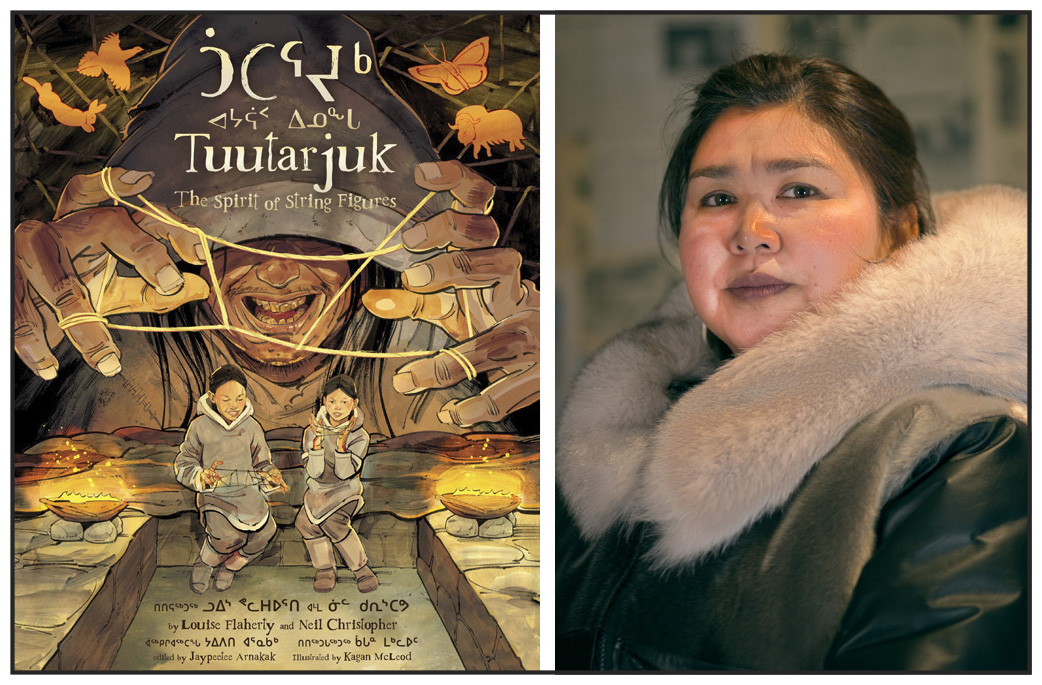
Image Caption
Windspeaker.com Books Feature Writer
Local Journalism Initiative Reporter
As a young child, Louise Flaherty recalls her grandmother warning her that bedtime meant sleeping or very, very bad things could happen. Take for example the spirit of Tuutarjuk, which “might come in and start playing with my entrails.”
That creepy image is captured enticingly in both the Inuktitut and English language words and the artwork in Flaherty’s newest book Tuutarjuk: The Spirt of String Figures, which is aimed at readers nine to 13 years of age.
“As children, once something is introduced to us we get so fixated on them to the point of almost obsession,” said Flaherty, who grew up in Clyde River, an Inuit hamlet on Baffin Island, Nunavut.
“When we got into creating shapes with our strings, we would have the strings with us as bracelets or as necklaces just so that we could be able to compete again. We have all sorts of beliefs about traditional string games.”
Tuutarjuk is one of the first string figures that young Inuit children learn. They begin playing with string at around six years of age to help build their fine motor skills.
In Tuutarjuk, sisters Nyla and Sima pass the time challenging each other at string games. But older sister Nyla is obsessed and boastful. Grandmother Nanngaaq warns Nyla that “Tuutarjuk is the spirit of string figures. It is a strange being that knows how to make hundreds of string figures, maybe even thousands. If a child doesn’t listen to their parents or Elders and continues to play with string when they should be asleep, sometimes Tuutarjuk comes and challenges them.”
However, Nyla is confident that her skills will allow her to beat Tuutarjuk. But can she really?
Flaherty, who is a fluent Inuktitut writer and speaker, wrote Tuutarjuk in Inuktitut. It was translated into English by Neil Christopher.
“You stick with the storyline rather than making (translation) literal, because otherwise it would not make any sense at all,” said Flaherty.
In translation, she adds, the rich Inuktitut vocabulary and terminology is lost.
The work was edited by Jaypeelee Arnakak, who took the high-level writing and longer story and adapted the Inuktitut text to fit the age range and format required for the picture book. Arnakak is a leading Inuktitut linguist.
Pages have alternating Inuktitut and English paragraphs so both Inuit and English readers can enjoy the tale.
The “warm and cozy” illustrations by Kagan McLeod, which Flaherty says represents her grandparents’ generation, are balanced with the dark and moody drawings of Nyla string battling with Tuutarjuk.
“The story is there. So once we get those to the illustrator, then they have to look at it, visualize what it might look like,” said Flaherty, who is pleased with the final product. “You can't have an illustrator just randomly make a design or a figure of something that to us makes no sense. So we had to send copies of the figures.”
For Flaherty, keeping her Inuktitut language and culture alive goes well beyond writing books. In 2005, she founded Inhabit Media with Neil and Danny Christopher. It is the only literary publishing house in the Canadian Arctic.
Growing up in the Arctic, Flaherty experienced a Western-style education, reading about Hansel and Gretal, Rumpelstiltskin and other fairytales. She grew up seeing pictures of apple trees although she lived on the tundra. Giraffes and elephants were depicted on flashcards instead of caribou and hare.
“I didn't see myself in a lot of the books and the resources that teachers shared. I used to hear storytellers talking, but in school it was all Western resources that were used,” she said. “My purpose is I want to make sure that my Inuk children, grandchildren, great-grandchildren have access to see themselves in the books to be exposed to their culture, which we weren't. To me, that's very important. We have our own stories.”
Flaherty admits that even today when she gathers with her siblings, string art can still figure prominently.
“I'll ask my little sister, ‘How do you make the wolf again?’ Because I do know the basics like the caribou, the rabbit and others, but she'll do... all sorts of shapes that she learned,” said Flaherty. She notes she left Clyde River in her late teens and her siblings stayed and “knowledgeable people about string games came to school to share their practices and my siblings learned more string figures than I did.”
As a teacher, Flaherty said she also practiced in her classroom the art of creating string figures and the stories attached to them.
Tuutarjuk: The Spirt of String Figures is published by Inhabit Media and will be released Sept. 8. It can be purchased through https://www.indigo.ca/products/tuutarjuk-the-spirit-of-the-string-figur…