
Image
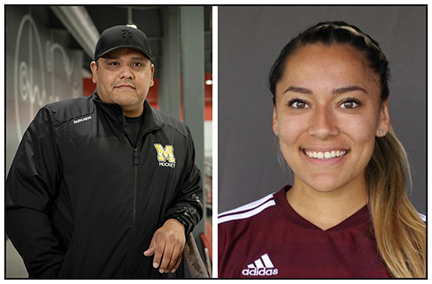
Image Caption
Local Journalism Initiative Reporter
Windspeaker.com
A pair of coaches who have achieved success while working with young Indigenous athletes have been recognized nationally for their efforts.
Dale Bear, a member of Peguis First Nation in Manitoba, was named the male winner of the National Indigenous Coaching Award this year.
The female recipient is Victoria Marchand, a soccer coach who is a member of Kitigan Zibi Anishinabeg First Nation in Quebec.
Both Bear and Marchand received their awards at the National Indigenous Sports Gala held in Ottawa on Oct. 24.
Athletes who captured provincial/territorial and national Tom Longboat awards were also honoured at the ceremony.
Bear joined the Manitoba girls’ entry at the National Aboriginal Hockey Championships (NAHC) in 2013 as an assistant coach. He took over the club’s head coaching duties the following year, a position he continues to have.
Over the years Bear has led Manitoba squads to five gold medals at the NAHC, including victories at the 2025 and ’26 tournaments.
Bear was asked his thoughts on being named top male Indigenous coach in Canada.
“I don’t know about that,” he said. “Maybe I just got lucky on the selection. But I know there's a lot of really good coaches out there. I don't like accepting awards, but I'll accept this one.”
Besides leading Manitoba clubs to five championships, Bear also has won four other medals (one silver and three bronze) at the NAHC.
He has also served, primarily as a head coach, with the Prairie Blaze, a team comprised of players ages 18 to 21 in the Manitoba Women's Junior Hockey League, since 2015.
Work commitments prevented Bear from coaching the Blaze last season, but he returned to the organization this year as an assistant coach.
“Work is very busy for me right now,” said Bear, who lives in Winnipeg and works as a project manager for a construction company. “So, I'm not there every single practice. I didn't want to take that (head coaching) title, so I handed that title off to one of my assistant coaches who is a very committed coach.”
This isn’t the first time Bear has been awarded a prestigious award for his bench work.
Back in 2021 he was selected as the Coach of the Decade (2010 to 2020) by the Manitoba Aboriginal Sports and Recreation Council.
“I do take a lot of pride in the Manitoba award,” Bear said. “But it's kind of hard to top a national award.”
Bear, who is 47, said he has no interest in moving up in the coaching ranks. In fact, his time working the bench with the Manitoba squad at the NAHC might be winding down.
“Actually, what my plan is is just to keep trying to produce my alumni players to be coaches and try and help mentor them to eventually take over from me,” he said. “So, I think I have a good crew right now that I feel that in the next very short span here that they can eventually take over for me as head coach.”
Bear, however, is hoping to continue to be a part of the Manitoba club. Ideally, he wants to assist his wife, who has been the long-time manager of the program.
As for Marchand, she’s the head coach of the Nautsa’mawt FC Academy, a virtual academy that includes more than 40 First Nations soccer players ages 13 to 18.
All of the academy participants live in British Columbia.
“Then they get paired with mentors that are all across the country that are former varsity athletes, former Team Canada players,” Marchand said. “There's a mix of Indigenous and non-Indigenous mentors.”
Up to four athletes are then paired up with either one or two mentors.
“They work through the year together, kind of like bonding,” Marchand said. “And also, the mentors really help them through different challenges.”
Marchand’s role is overseeing all of the mentorship and also the program’s tactical and technical aspects.
“It's one of the only pathways that exist like that for these kids, which is really incredible,” she said. “I'm just super happy to be a part of it.”
Marchand said soccer in B.C. is extremely popular.
“But for the rest of Canada it's not something that is like super well known. It’s not like hockey. It's not like lacrosse where it's an Indigenous sport. Soccer is more under the radar as a sport for Indigenous athletes, I feel, nationally.”
Marchand has a good idea of why that is the case.
“We've never had professional women’s soccer players,” she said. “And we've had very few Indigenous men's soccer players. So, there's just a lot of wiggle room to kind of like develop more role modelling and mentorship and leaders in the space. And I think it's just the beginning of what we're able to do.”