
By Shari Narine
Windspeaker.com Books Feature Writer
Local Journalism Initiative Reporter
The nêhîyawêwin (Cree) language has always been important to Saddle Lake Cree Nation member ᑳᐯᓵᑳᐢᑌᐠ reuben quinn.
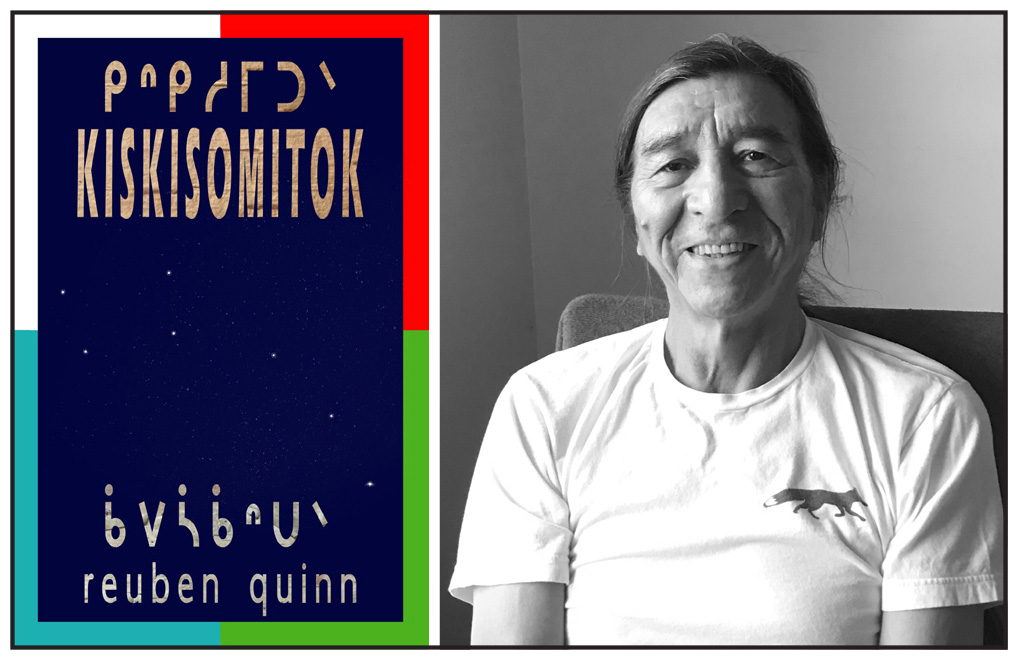
nêhîyawêwin, its connection to the land and its teachings, are the focus of quinn’s book ᑭᐢᑭᓱᒥᑐᐠ kiskisomitok: to remind each and one another.
quinn writes that neither his name nor nêhîyawêwin words are capitalized because “when you are sovereign and you don’t owe anyone anything, then your name is in all lower case.”
A long time nêhîyawêwin language teacher with the Centre for Race and Culture in Edmonton, among other organizations, quinn turned his attention to writing kiskisomitok after a medical diagnosis.
“I was dying of cancer…I was given six months to live,” he said. “I went and got medicine from Saddle Lake and I was able to live past that six months. I got two-and-a-half, almost three years of extra days.”
quinn, who resides in Edmonton, wrote the book at the behest of settler scholar Christine Stewart, who he taught with for a number of years. The conversations the two had about the nêhîyawêw teachings were recorded. Stewart transcribed them and provided editorial assistance for the book.
kiskisomitok is a finalist for the Wilfred Eggleston Award for Nonfiction. The award will be handed out June 5 by the Writers’ Guild of Alberta.
While quinn says he doesn’t “have any feelings” about his book being shortlisted, he is hoping that the extra attention will help kiskisomitok “reach those people that want to explore the culture and the paradigm of the nêhîyawak philosophies and culture.”
He writes, “…colonization and genocide took our religion, our land, our faith, and our confidence. I wanted this book to bring back that reality that this was once the land that the moccasins of my ancestors touched, as far as the sun shone. I want the book to remind people that there was a way to live before colonization, and there still is, and it still works.”
In kiskisomitok quinn introduces readers to the spirit markers (atâhkipêyîhkanak) and the first four laws in the spirit markers.
There are 44 large spirit markers and 14 small spirit markers and “each large spirit marker represents a sound, holds a law and the spirit of that law,” writes quinn.
The first four laws are: Love each and one another (a sâkîyîtok); help each and one another (pa wîcîyîtok); be happy, have fun, enjoy (ta mîyowâtamok); and be disciplined, make it strong, stay strong (la sôhkastwâk).
Four laws are enough, writes quinn, who pulls on his brother Carl’s reasoning: “If you get the first law (a sâkîyîtok)…then the others are woven into place.”
kiskisomitok also examines the “paradigm difference” between the colonizers and nêhîyawak.
“(nêhîyawak) belong to the land and we don't own the land. We don't have that type of mentality,” said quinn, unlike colonizers. “When we look to those ecosystems as relatives rather than a commodity then things work out better for people that way.”
quinn also points out that nêhîyawak and colonizers have a different view on what nêhîyawak call “animate beings.”
“All things made animate are spirits or have spirits,” he writes, including the sun, the wind, the earth and the water.
“When you are on the land you start remembering – the land helps you remember. To remind each other of love. To remind each other of natural law,” quinn writes.
kiskisomitok also looks at how many nêhîyawêwin words have had syllables removed.
“With each syllable loss is the loss of…a spirit marker. And each…(spirit marker) holds the meaning of life within its own context,” he writes.
Colonization brought about this loss, says quinn, who offers a theory for the need to contract nêhîyawêwin words. With Indigenous languages, such as nêhîyawêwin, banned in residential schools and family members not allowed to spend time together, when brothers and sisters passed in the hallways they would whisper to each other in their language.
“They probably needed to shorten (their words),” he said. “They had to change the dialect.”
Even though he taught the language for 20 years, quinn does not consider himself a fluent nêhîyawêwin speaker as he can’t carry on a conversation at length. Speaking nêhîyawêwin is energizing, he says, “awesome and amazing.” However, the lack of vocabulary—there were 600,000 words and today there are only 30,000 words—is his stumbling block.
“All I would be doing would be repeating things and trying to figure out ways to say things although I know that there are more succinct nêhîyawêwin words or expressions,” said quinn. He notes that while he immediately recognizes when he’s conversing with a fluent nêhîyawêwin speaker, they also know immediately that he is a semi-fluent speaker.
“For this book,” said quinn, “I want people to know that in spite of all the exclusions that happened, we still have a very vibrant culture. And by culture, what I mean by that is dance, dialect, dress, and diet.”
ᑭᐢᑭᓱᒥᑐᐠ kiskisomitok: to remind each and one another is published by Talonbooks and was released in July 2025. It can be purchased through https://www.indigo.ca/en-ca/kiskisomitok-%E1%91%AD%E1%90%A2%E1%91%AD%E1%93%B1%E1%92%A5%E1%91%90%E1%90%A0-to-remind-each-and-one-another/9781772016444.html